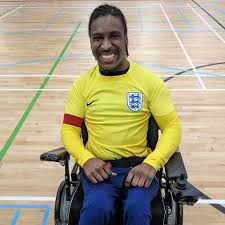
As Kyle Alexander sat on the bench waiting for his opportunity, he couldn’t tell if the sweat was due to the humid Florida climate or the nerves. One thing was for certain, his heart was threatening to beat right through the three lions adorning his chest. Then the call down the line. He was only 16 years old, but he was about to realise a dream shared by millions around the world, to represent their country at a World Cup. That was meant to be the start of a long and successful England career, but life is unpredictable, and it didn’t turn out that way. Now he’s on the comeback trail, determined to get back that hallowed summit.
Sport has always been a key part of Alexander’s life. Playing wheelchair basketball and powerchair football alongside each other regularly, in the beginning he found himself restricted by his disability, longing for a way to experience the thrill his older brother got from playing football.
“I have always loved football for as long as I can remember and grew up watching my brothers’ games on the side cheering him on but also wishing I could get a chance to feel the thrill too” says Alexander, a smile on his face as he remembers his early childhood. “So, when my best friend Shea French Gibbons told me he was starting a local club in his area and asked me to come along, I jumped at the opportunity in all honesty.”
Alexander felt supported in his career from day one at Greenwich PFC (Powerchair Football Club). “My first coach organised players to come down to talk to us to keep us motivated and give us an insight to where our training would get us in the long run” he explains. “When the club acquired powerchairs I was very supported as they provided a playing chair, exciting coaching sessions and help with travel to get to games if it was needed.
Soon his talents were recognised by Sevenoaks PFC in Kent, where Alexander became a key part of their National League runs, winning promotion to the Premiership twice, and it wasn’t long before his talents caught the attention of the England set up.
“I was recruited to the England senior squad as Head Coach Colin Gordon was at a Premiership weekend where he watched the games and saw me and what I could do. We had a brief discussion after a game on Sunday morning and I was asked to come down for a trail day officially via email.”
Now for a 16-year-old in the middle of his final year of secondary school, being asked to trial out for the senior squad of your national team is a momentous occasion, but one that comes with a lot of new emotions to deal with. “Trial day came, and I just remember feeling a combination of slight nerves mixed in with a whole lot of feeling of joy and excitement. Playing at St George’s Park for the first time was monumental, moreover training with the squad whilst having that England crest on my chest was an unforgettable moment.”
After a successful trial, Alexander was selected in the squad heading to Kissimmee, Florida. However there were a lot of challenges to deal with back home at the same time, something he felt immensely supported.
“Due to me having the great honour of being selected when I was 16 I got great support both from my coaches and teammates at England, as well as at club level as I had to sit my GCSEs prior to the tournament. I brought work with me to some camps leading up to the tournament so when we were not on court training or having time as a team I could balance it out and get some revision in.”
In Florida, Alexander was the youngest in the squad by a few years, and that kid who had grown up watching his brother play football was now about to represent his country at a World Cup, and he was determined to make the most of the opportunity. “Going into the tournament I knew I had a great team around me full of knowledge, technical skill, and a deep drive to win. Being the youngest member of the squad, I tried to be like a sponge and soak it all in whilst working on my game.”
Alexander would make his debut against Argentina, a rivalry that is famous for the late, great Diego Maradona’s infamous ‘Hand of God’, and made a further appearance against the Republic of Ireland. He returned home with a bronze medal, dreaming of the next opportunity he’d get to pull on the Three Lions. But that opportunity never came.
“Being dropped from the squad after the World cup was difficult”, says the 23-year-old, his shoulders slumping as if he had just heard the news for the first time. “You always want to be in the squad and playing at your best.”
Despite the setback, the man born in Lewisham viewed it with optimism, taking a positive mental attitude into everything he does.
“Sport really is a journey, and it may not always be on an upward trajectory, so you have to take things in your stride and really appreciate the present moment” he surmises philosophically. “It did teach me a lot about perspective as I could have been disheartened about not being involved in the next major tournament, but I felt it was even more effective for me to use it as fuel to further propel myself to where I want to be, back in the squad helping my teammates with the objectives that were set.”
After dropping out of the squad, Alexander found himself in the FA’s newly formed National Talent Pathway, a programme designed to identify young players with the potential to represent their country and give them additional, specialist training so they are ready to compete straightaway should they get the call up.
“It was vital that I fell into the player pathway” he affirms with a sense of purpose. “It allowed me to further develop the system we were going to play with the senior side, offered me an opportunity to work on my craft with an excellent level of coaching and a talented group, whilst also giving me the opportunity to further work on my psychological side of the game, whether that be in game or the mentality I had when approaching games.”
The talent pathway allowed Alexander to captain his country, leading the England Development Squad to two victories in the Home Nations Tournament, first in Belfast two years ago and then again in Largs, Scotland last year.
“The pathway allowed me to develop the skill of leading on an international level whilst also working on how to deal with the pressures that come with the elite side of the game. I personally believe sometimes this can get overlooked and the best players are those who can consistently bring the best.”
Still at Sevenoaks PFC, the club captain has spent the last couple of seasons developing his game, helping to keep his side in the Premiership, and using the talent pathway to help not only his game, but his mental state away from the court.
“I believe the pathway has helped me further along the process of getting rid of limiting beliefs or rigid ways I may have held beforehand”, he explains. “I have become a more complete player, despite some recent dips in confidence, and that is something I believe I can credit to the pathway as they have aided me on my journey to becoming the best player I can be, and there is still a long way to go yet.”
Alexander’s career so far is a story of a sharp rise to the top, followed by a large setback which he has had to recover from. Now on the comeback trail, the next chapter in his footballing story is yet to be written, but it promises to be a gripping read.

 Gregg Covers Sport
Leave a comment