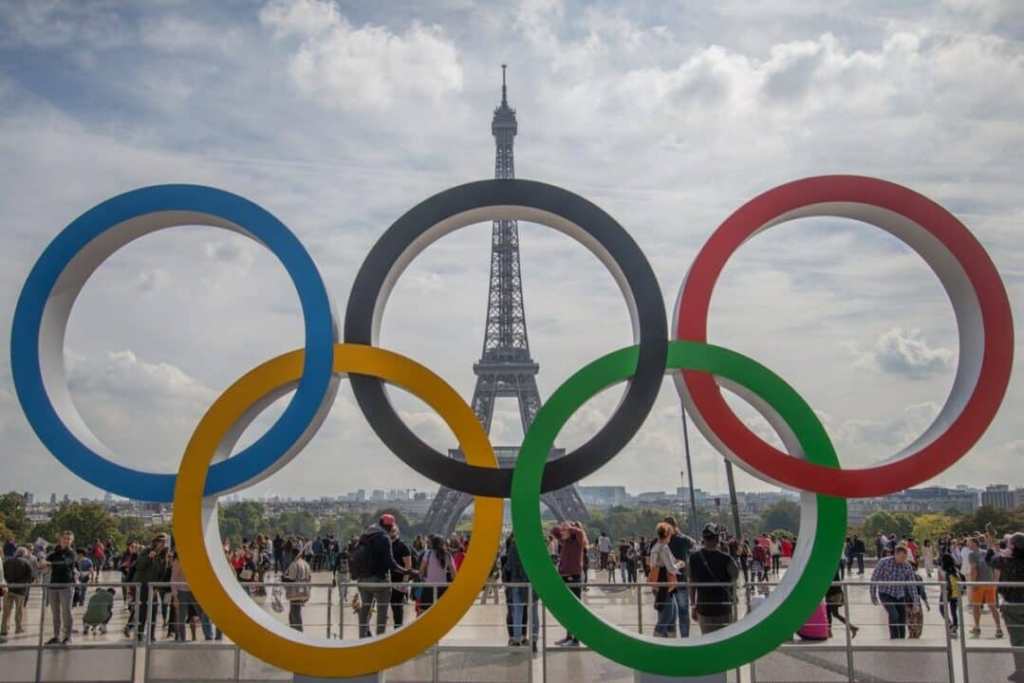
Sunday saw the curtain close on the 33rd edition of the modern Olympics, with a large dose of glitz and glamour giving us a taste of what is likely to come in four years’ time, when Los Angeles plays host to the world’s greatest athletes. Outgoing IOC (International Olympic Committee) President Thomas Bach called the games “sensational,” or “seine-sational,” but has that really been the case? Here’s four highlights and four lowlights from the last two weeks of competition, starting with the moments that will be remembered fondly.
Gymnastic Podium Photos
The ‘spirit’ of the games was on full show atop the podium throughout the various gymnastics’ disciplines. Two moments stand out though. Firstly, after a tightly contested women’s’ beam final, Italians Alice D’Amato and Manila Esposito did the iconic ‘bitten medal’ pose with their respective gold and bronze medals stood on the podium. China’s Zhou Yaqin, who took the silver medal, gave her fellow medallists a slightly puzzled look, wondering why anyone would want to bite into solid metal. Not wanting to be left out, the 18-year-old followed their lead and put her new medal to her lips, providing the photographers with the complete picture.
Secondly, after initially making history with the first all-black gymnastics podium in Olympic gymnastics history, Team USA’s silver and bronze medallists Simone Biles and Jordan Chiles decided to honour Brazil’s Rebeca Andrade who had won gold. After receiving their respective medals, Biles and Chiles turned to face each other and bowed as Andrade was announced to the crowd, jumping on to the top step of the podium with both fists raised above her head in triumph and a beaming smile on her face.
While the photo will go down as one of the most iconic to come out of the Paris Games, the controversy in the aftermath means this moment may make an appearance later.
Hometown Heroes
Whichever country hosts the Olympics, there is always a ramping up of the support for their star athletes. However, with that increased support also comes an increase in pressure and expectations to deliver in their nation’s biggest moments. For France this summer, their big guns certainly produced when it mattered. The face of these games was undoubtedly 22-year-old swimming sensation Leon Marchand, and the large cries of support that rang around the Paris Olympic Aquatic Centre seemed to add extra power to each of his strokes through the water as he produced dominant display after dominant display to win four individual gold medals. There was also time for him to help his country claim a bronze medal in the 4x100m Medley Relay too, stamping his authority on the competition.
From the smooth water to the rugged terrain of the BMX Sprint track, and arguably France’s greatest achievement of their games. Under the setting sun at the Place de la Concorde circuit, an expectant yet nervous crowd sat waiting for their stars to deliver. Of the top ten male sprinters in the world, seven of them are French, but they could only select three to compete for the medals. Whilst they clearly had the best chance of winning the gold, there was a worry that intra-camp politics and personal ambitions could ruin their chances. After all three riders safely navigated their way to the final race, the nation held its breath, but in a remarkable display of sportsmanship all three put any rivalries aside to secure a momentous clean sweep of the medals. Senior rider Joris Daudet led his compatriots Sylvain Andre and Romain Mahieu over the line, sparking wild scenes of jubilation.
It would be remiss of me not to also mention reigning XC mountain bike world champion Pauline Ferrand-Pervot who, in her final ever race, won the Olympic gold medal on home soil. The 32-year-old can now ride off into retirement after getting the perfect ending to her career.
The fastest race, and the closest finish
The men’s 100m race is one of the most watched Olympic events every four years, with minds-cast back to the great battles between the iconic Usain Bolt, Yohan Blake, and Tyson Gay in London twelve years ago (Gay would later be stricken of his silver medal from 2012 after being suspended for failing a drug test). The race this year, however, took it to a level not seen before. All eight finalists ran a time under 10 seconds for the first time in history, and all finished within 0.12 seconds of the gold medal time set by Noah Lyles of the USA who ran a 9.784, five-thousands of a second quicker than pre-race favourite Kishane Thompson who posted a time of 9.789. The scoreboard immediately after the conclusion of the race had both Lyles and Thompson tied with a time of 9.79, and it took the closest photo finish ever to separate them. Defending champion from Tokyo three years prior, Italian Lamont Marcell Jacobs missed out on a medal entirely. Lyles, who was last through the first 40m, stormed through the pack to snatch gold by the barest of margins.
First-time medallists
Whilst the usual suspects dominated the medal table yet again in Paris, there were also four countries who won their first ever Olympic medals this time around. Thea LaFond leaped to victory in the women’s triple jump to win the Caribbean Island their first ever medal, whilst Julien Alfred became the fastest woman in the world by winning the 100m’s for neighbouring Saint Lucia. Another island nation that won their first medal in Paris this year was Cabo Verde. Despite sending just seven athletes to compete, their flag-bearer David de Pena won bronze in the men’s 51kg boxing. Finally, Albania’s Chermin Valiev took bronze in the men’s 74kg freestyle wrestling to claim their first ever medal. The Refugee Olympic Team, who first competed in Rio in 2016, also won their first ever medal when Cindy Ngamba won bronze in the women’s 75kg boxing.
There were also first-time gold medals for Guatemala and Botswana, with Adriana Ruana Oliva taking gold in the women’s trap shooting for the former, while Letsile Tebogo became the first African to win the men’s 200m for the latter.
Now for those moments in Paris that the IOC would like forgotten quickly.
Boxing’s gender equality controversy
This is an easy one to start with. No story caused more debate and controversy in Paris than the inclusion of Algeria’s Imane Khelif and Taiwan’s Lin Tu-Ying in the women’s boxing competition, despite both having been disqualified from the Women’s World Boxing Championships last year.
The Russian-led International Boxing Association (IBA) said last year that two blood tests conducted on both fighters “conclusively indicated” that “didn’t match the eligibility criteria for IBA women’s events,” and as such the pair were banned from taking part. IBA President Umar Kremlev has since claimed that the tests showed both fighters were “genetically male.”
However, the IOC was responsible for the running of the boxing competition at both the Paris and Tokyo Games after the IBA was stripped of its official status last year after failing to make reforms after being initially suspended in 2019 after concerns over its integrity and governance. The IOC, who has less stringent gender eligibility rules than the IBA, has continually recognised both athletes as women, stating they were born and raised as women.
Both Khelif and Tin-Ying won gold in their respective weight categories, but their victories have been tainted in the eyes of many around the world. After beating China’s Yang Liu in the final of the women’s 66kg event Khelif told reporters:
“I was born a woman, I lived as a woman, I competed as a woman – there is no doubt” before going on to add “I want to tell the world that they should commit to the Olympic principles, and they should not bully people.”
However, some, including tennis legend Martina Navratilova, hit out at the IOC for their decision. Navratilova, who has also been a long out-spoken opponent of trans women competing in women’s sport, tweeted saying that “it is a travesty, and makes a mockery of all Olympic sports.”
Seine Sewage
The men’s triathlon was delayed by unacceptable water quality readings in the River Seine, which was set to host the swimming leg of the race. The organising committee had invested large sums of money into preparing the river as best as it could before the Games got underway, including building a giant basin to catch any excess rain water and to keep untreated waste from flowing into the river, as well as upgrading the water treatment plants and renovating the sewage system.
Despite this, the men’s triathlon, which was originally scheduled to take place on the 30th July, had to be postponed until the following day, when the women’s event was due to take place, because the water was deemed to be unsafe to swim in. On the 31st July, the women’s triathlon took place at 8:00am, before the men got underway at 10:45am. Both events were completed without a hitch seemingly, and everyone hoped the mixed triathlon relay scheduled for August 5th would also go just as well.
However, the evening prior to the mixed relay triathlon, it was revealed that Belgium had withdrawn due to one of their female triathletes Claire Michel being hospitalised due to an E. Coli, just days after she had swum in river for the first time. She wasn’t the only casualty either, with NBC reporting that Swiss triathlete Adrien Briffod had also withdrawn from the mixed relay after suffering a stomach infection, casting a shadow over what were three fantastic races.
Gymnastics score chaos
I referenced earlier that the women’s floor final may get a mention in both sections, and it certainly deserves its place here. American Chiles had initially scored 13.666 which was only good enough for 5th place. Romanian gymnast Ana Barbosu, who scored 13.7, had begun celebrating the bronze medal she thought she’d won, draped in a Romanian flag and smiling with joy.
Then, after an inquiry was lodged by Chiles coach Cecile Landi, it was announced to the crowd that the American’s score had been upgraded to 13.766, giving her the bronze medal and dropping Barbosu into fourth, leaving the Romanian heartbroken, tears flowing down her face as she had seen herself awarded and then stripped of an Olympic Medal all in the space of five minutes. This led to the viral photo of Chiles and silver-medallist Simone Biles bowing either side of Brazil’s gold medallist Rebeca Andrade on the podium.
The Romanian Olympic Committee protested the decision and appealed to the Court of Arbitration for Sport (CAS), alleging that the initial American inquiry had been placed four seconds after the permitted one-minute time limit. It even went as far as Romania’s prime minister Marcel Ciolacu threatening to boycott the closing ceremony, calling the entire situation “scandalous.”
CAS sided with the Romanians, and Chiles original score was eventually reinstated 5 days later. Barbosu will soon have a reallocation ceremony, giving her the podium moment she originally missed out on.
Skeet shooting showdown
After three rounds of the four-round shoot-off in the women’s skeet shooting final, Team GB’s Amber Rutter was tied with Chile’s Francisca Crovetta Chadid. What happened next caused controversy that is still yet to be settled. Rutter was adjudged to have missed one of her next two shots, despite slow-motion TV replays appearing to show she hit both targets. Crovetta Chadid hit her next two targets to secure her countries only gold medal in Paris and their first ever shooting gold. Rutter lodged an appeal, but all three judges upheld their initial decision.
Despite being used at other International Shooting Federation (ISF) events, shootings version of Video Assistant Referee’s or Hawkeye is not used at the Olympics. In a lengthy statement posted to her Instagram, Rutter asked for an apology from the ISF and IOC.
“I feel like I owe it not just myself but the entire shooting community to highlight and address the matter” the 26-year-old said. “Every athlete, especially at the Games deserves to compete on a fair playing field.
“I do believe some accountability needs to be taken to acknowledge and an apology for the incorrect decision ultimately costing me an opportunity of winning an Olympic gold medal.”
Although the Olympics may be over, the sporting action in Paris this summer isn’t, with the Paralympics getting underway on August 28th and running until September 8th, where more memories and highlights will be made.

 Gregg Covers Sport
Leave a comment